The Truth About Omar Suleiman’s PhD
A Forensic Investigation into Academic Fraud
behind the facade
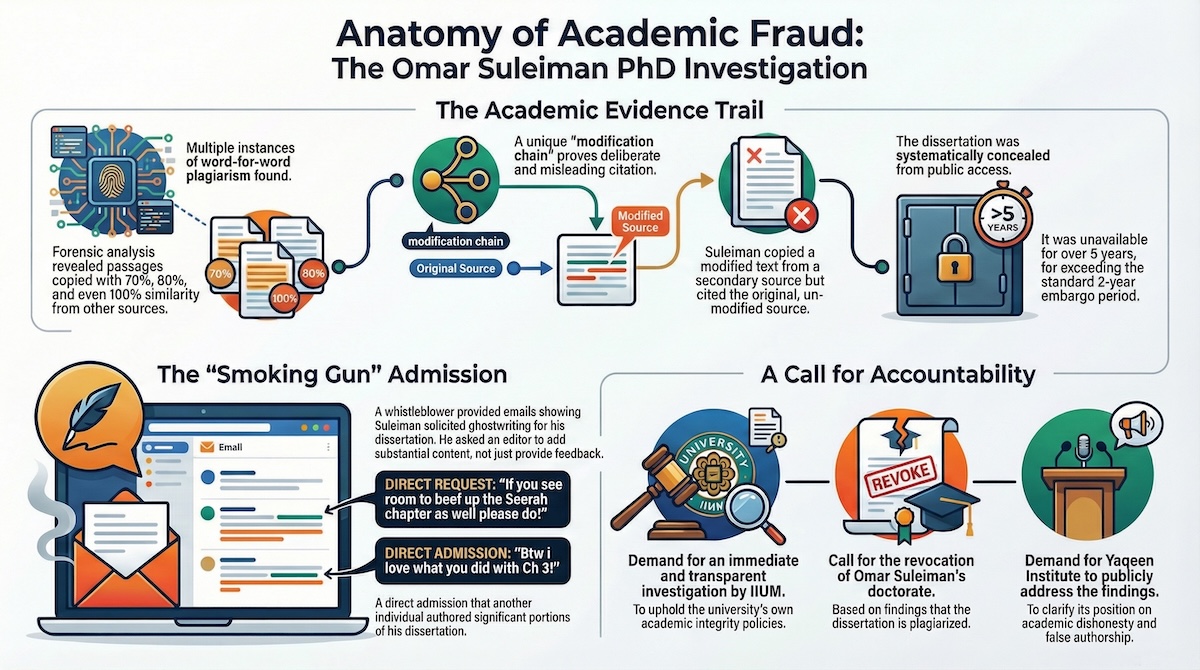
Omar Suleiman, a widely respected Islamic scholar and founder of Yaqeen Institute, stands accused of academic fraud in the form of plagiarism. A team of academic investigators has uncovered extensive evidence suggesting that Suleiman’s doctoral dissertation, submitted to the International Islamic University of Malaysia (IIUM), violates multiple standards of academic integrity.
This investigation is not based on speculation or hearsay — it is grounded in verifiable evidence and rigorous analysis.
Word-for-Word Plagiarism
Word-for-word plagiarism refers to the act of copying exact sentences, phrases, or passages from another author’s work without proper citation or quotation. This type of plagiarism is the most direct and unmistakable form of academic dishonesty because it involves reproducing someone else’s language and ideas as one’s own. In scholarly writing, it is not enough to slightly rephrase a sentence or change a few words — proper attribution, quotation marks, and citations are essential when using another person’s expression verbatim. In Omar Suleiman’s case, multiple sections of his dissertation include sentences and paragraphs lifted directly from previously published works, with little to no modification, and without acknowledging the original sources. This constitutes a clear and serious violation of academic ethics.
Citation Lifting
Citation lifting occurs when a writer copies references, footnotes, or cited sources from another academic work without actually consulting or engaging with those original materials. Instead of conducting independent research, the writer mimics the citation trail of another author, creating the false appearance of scholarly depth and original study. This practice is deceptive because it misleads readers into believing the author has personally reviewed and evaluated each source. In Omar Suleiman’s dissertation, extensive analysis revealed that many citations were copied wholesale from prior Yaqeen Institute publications, written by different authors — without attribution — even including the same sequence, phrasing, and contextual framing.
Concealment of the Dissertation
Transparency is a cornerstone of academic scholarship — dissertations are meant to be publicly accessible so that peers can review, critique, and build upon the research. However, in the case of Omar Suleiman, his PhD dissertation remained inaccessible through official IIUM channels for over five years, far exceeding standard embargo periods which typically range from two to three years. Numerous requests from academics, students, and even IIUM faculty to access the document were ignored or denied. Direct inquiries to Suleiman himself were delayed, subtly declined, or left unanswered. Most alarmingly, in March 2025 — just weeks after Suleiman’s visit to Malaysia — all known online links to the dissertation were abruptly deactivated. This pattern of obstruction raises serious concerns about intentional efforts to suppress access to a document now proven to contain academic misconduct, and it further implicates potential institutional complicity or undue influence.
KEY EVIDENCES
THE WHISTLEBLOWER
These three screenshots represent the most decisive and irrefutable evidence uncovered in this investigation.
They are not interpretations. They are not second-hand claims. They are direct communications originating from Omar Suleiman himself, exchanged during the period in which his doctoral dissertation was being completed. In these messages, Omar Suleiman explicitly requests assistance that goes far beyond proofreading or general feedback. The language used makes clear that he was seeking structural guidance, substantive contributions, and written material for specific sections of his dissertation.
This evidence removes all ambiguity.
Under universally accepted academic standards, soliciting or receiving such assistance for a doctoral dissertation constitutes academic cheating and qualifies as academic fraud.
Academic integrity allows for editorial review and general feedback — it does not permit outsourcing the construction, framing, or writing of dissertation content. These screenshots demonstrate that such boundaries were crossed. They establish intent, timing, and substance in Omar Suleiman’s own words, directly contradicting any claim that his dissertation was solely his independent scholarly work.
Taken together, these communications function as the smoking gun of the investigation. They conclusively show that external assistance was solicited in a manner incompatible with doctoral standards, leaving no room for speculation, reinterpretation, or doubt.
EXHIBIT A
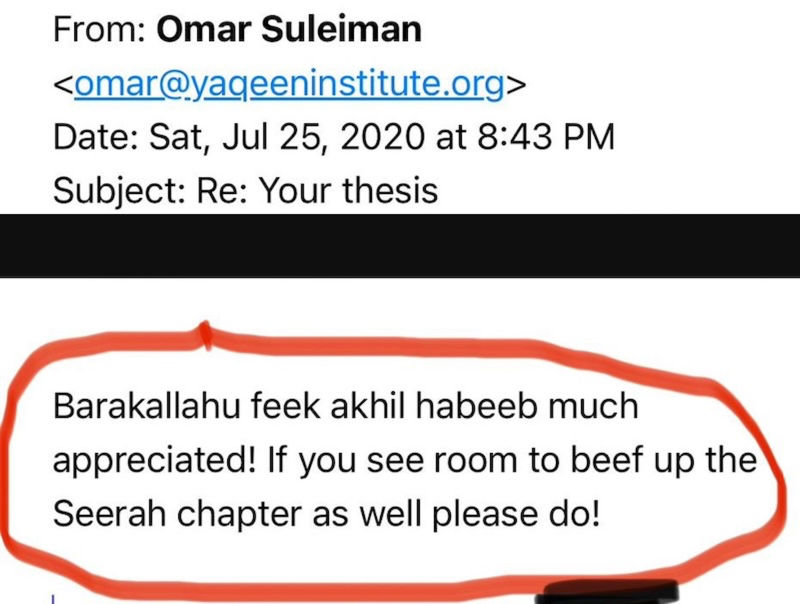
“Barakallahu feek akhil habeeb much appreciated! If you see room to beef up the Seerah chapter as well please do!”
EXHIBIT B
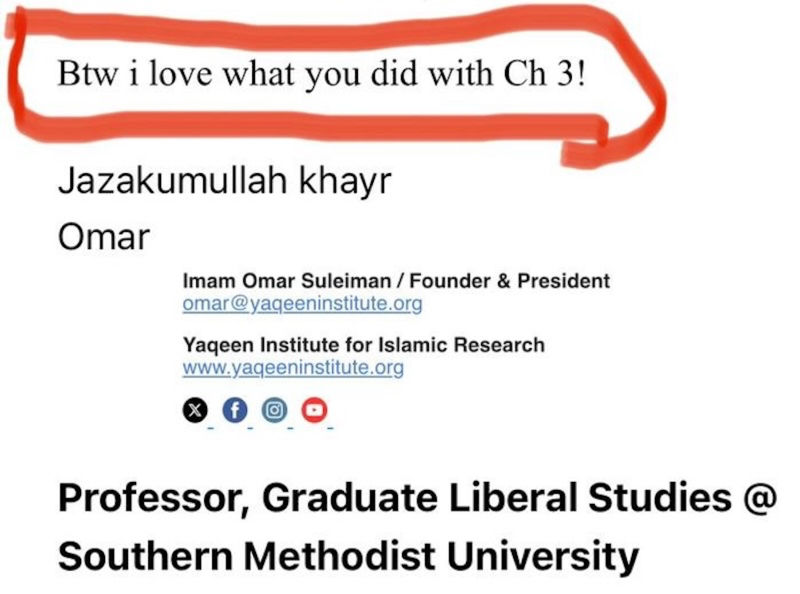
“Btw i love what you did with Ch 3!“
EXHIBIT C
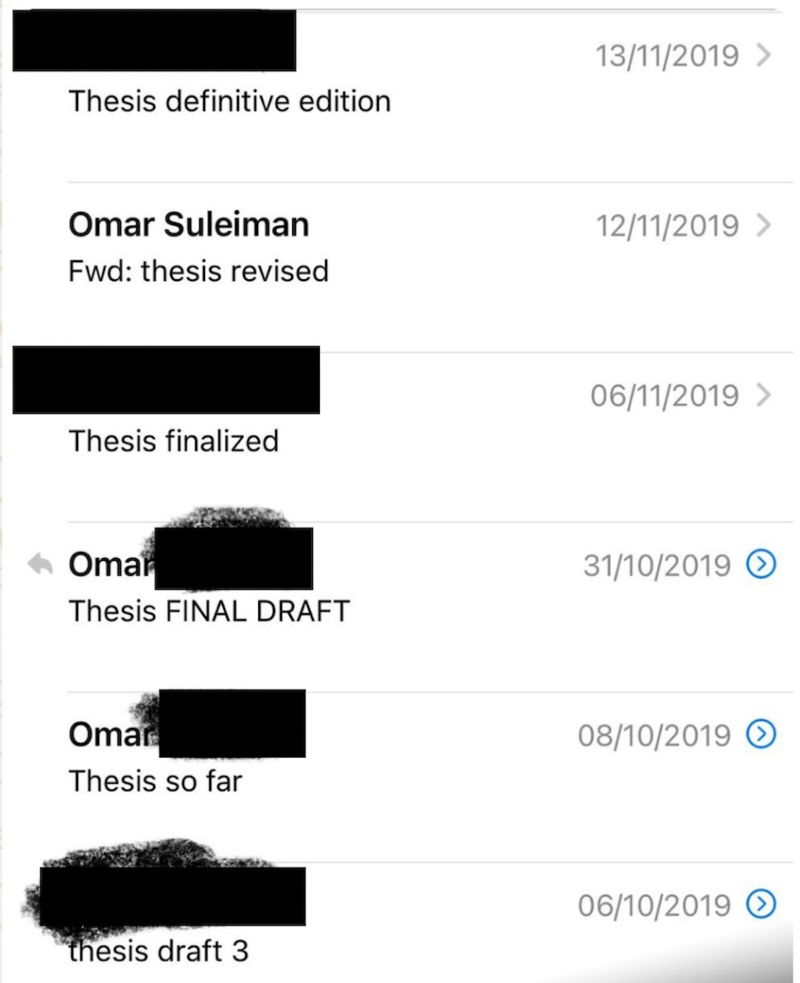
Email exchanges showing showing Omar Suleiman’s collaboration with the whistleblower
THE INVESTIGATION
Plagiarism Investigation Report
The document below is a comprehensive, 45-page forensic investigation into Omar Suleiman’s doctoral dissertation submitted to the International Islamic University of Malaysia (IIUM). Compiled by a team of PhD scholars and academic integrity experts, it details multiple instances of plagiarism, citation manipulation, and scholarly misconduct. The report includes side-by-side textual comparisons, and documented violations—providing clear, verifiable evidence of academic fraud.
OS Dissertation
↑ click for interactive viewer
Omar Suleiman's Dissertation
Author: Omar Suleiman
Paper: A Heurmenutical Understanding of Jihād Through Its Historical Contingencies
Plagiarized Source Materials
Reference #: 1
Author: Justin Parrott
Paper: Jihād as Defense: Just-war theory in the Quran and Sunnah
Reference #: 2
Author: Surkheel Sharif
Paper: Is Islam a Conquest Ideology? On Jihad, War, & Peace
Reference #: 3
Author: Hassan Shibly
Paper: War, Islam, and the Sanctity of Life: Non-Aggression in the Islamic Code of Combat
Reference #: 4
Author: Justin Parrott
Paper: Jesus: A Foundation for Dialogue Between Muslims and Christians
Reference #: 5
Author: Mohammad Elshinawy
Paper: The Accomplishments of the Prophet ﷺ: The Proofs of Prophethood Series
IIUM Academic Integrity Rules
6. Plagiarism
6.1 — Plagiarism is defined as;
(a) the act of taking of intellectual property expressed in material form, writing, data or invention of another person and claiming that the idea, writing, data or invention is the result of one’s own findings or invention; or
(b) an attempt to make out or the act of making out, in such a way that one is the original source or the author of an idea expressed in material form, writing, data or invention which has actually been taken from some other sources.
6.2 — A staff or student is deemed to commit an act of plagiarism when he:
(i) publishes, with himself as the author of academic paper or book which is wholly or partly written by some other person;
(viii) extracts ideas with or without consent from another person’s writing or invention and makes certain modifications, without due reference or acknowledgement to the original source and rearranges them in such a way that it appears as if he is the inventor of those ideas.
13. Preliminary Investigation
(1) Where it appears that a person has committed an academic misconduct, the office in charge of academic may establish a committee to investigate the alleged misconduct and make a preliminary finding according to the prescribed
procedures and guidelines of the University.
(2) The office in charge of academic shall upon receipt of a finding may recommend the alleged misconduct to the Disciplinary Authority for disciplinary proceeding.
Document: International Islamic University Malaysia — Academic Integrity Rules
Original Link: https://office.iium.edu.my/ola/iium-academic-integrity-rules/
THE PATH FORWARD
This is not an innocent oversight. The patterns of plagiarism, citation misrepresentation, and access obstruction indicate deliberate academic misconduct. Omar Suleiman’s dissertation is not a valid scholarly work, and his PhD credential from IIUM is compromised.
Allowing this to go unchallenged would severely damage the credibility of IIUM and diminish the value of doctorates issued by the institution. It also sets a dangerous precedent for scholars globally.
Demand Accountability
We invite students, academics, and the public to take a stand for academic integrity.
📩 Email Template to IIUM
To: [email protected]
Subject: Urgent Request to Investigate Plagiarism in Omar Suleiman’s Dissertation
Dear IIUM Rector,
I am writing as a concerned member of the global academic and Muslim community to express deep concern regarding serious allegations of plagiarism found in Omar Suleiman’s doctoral dissertation, submitted to IIUM in 2020.
A detailed investigation conducted by a team of PhD holders and academic integrity specialists has revealed:
• Verbatim plagiarism from multiple Yaqeen Institute publications
• Deliberate misattribution of modified translations
• Citation lifting from intermediary sources without acknowledgment
• Attempts to conceal the dissertation from public access for over five years
The findings strongly indicate that Omar Suleiman has violated IIUM’s academic integrity policies. I respectfully urge IIUM to launch a transparent, independent review of the dissertation and take appropriate disciplinary action if the allegations are confirmed.
The reputation of your institution and the trust of the academic community depend on your response.
Sincerely,
[Your Full Name]
[Your City, Country]
[Academic or Professional Affiliation (if applicable)]
FREQUENTLY ASKED QUESTIONS
Who is behind this investigation?
For personal safety and to protect the integrity of the investigation, the author(s) have chosen to remain anonymous. The focus should remain on the evidence, not the individuals presenting it.
However, these are PhD-level researchers, professors, and plagiarism-detection specialists. They are affiliated with universities in California, Virginia, Malaysia, and Germany.
Why did you conduct this investigation?
We believe in academic integrity and public accountability. Plagiarism — especially by public officials who shape and influence public trust — should not be ignored or excused. This investigation is an attempt to bring transparency to light.
How did you conduct the investigation?
Using available documents (e.g. dissertations, books, speeches, articles) and standard plagiarism detection tools (e.g., Turnitin-equivalent software, manual analysis, and linguistic forensics), we identified patterns of unattributed copying and potential academic misconduct.
Are your sources verifiable?
Yes. All claims in this report are backed by direct comparisons between Omar Suleiman’s work and the original sources. We provide links, citations, or screenshots for verification.
Can this be faked or fabricated?
We welcome third-party experts, academics, and journalists to independently verify the findings. Transparency is built into the structure of this report.
Why didn’t you go to the media or authorities?
In cases involving powerful individuals, traditional channels often result in suppression, delay, or spin. Publishing anonymously allows the facts to reach the public directly without interference or bias.
Are you politically/ideologically motivated?
This report is about integrity, not ideology. Regardless of our personal stances or religious ideologies, plagiarism undermines merit, trust, and intellectual honesty. We would pursue this report regardless of affiliation to religion.
What do you want people to do with this information?
- Share it responsibly.
- Ask questions publicly and demand answers.
- Contact educational institutions or relevant oversight bodies if warranted.
What if this is part of a smear campaign?
We urge readers to look at the evidence, not the perceived motive. The truth should withstand scrutiny — regardless of who uncovered it.
Will there be follow-ups or more findings?
Possibly. If additional evidence comes to light or if institutions respond, we will publish updates through the same channel.
Can I contribute more information or documents?
Yes. If you have relevant information or expertise, you can submit it anonymously through [encrypted contact form / secure dropbox link].
*submission details will be updated soon